
Common materials and properties of shaft forgings
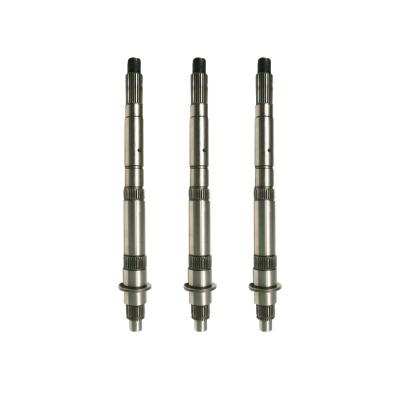
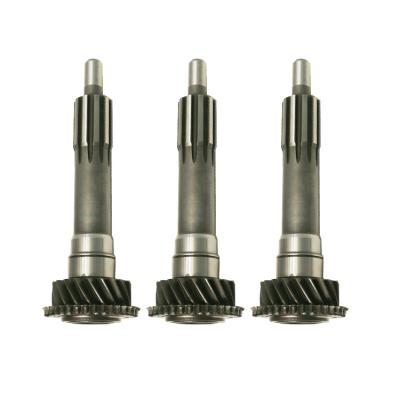
Shaft forging is a very widely used forging. This shaft has good machining performance. In practical application, it does not have any porosity and other defects, so it not only has a good appearance guarantee, but also has excellent performance. Let's introduce the shaft forgings that meet the requirements to be popular.
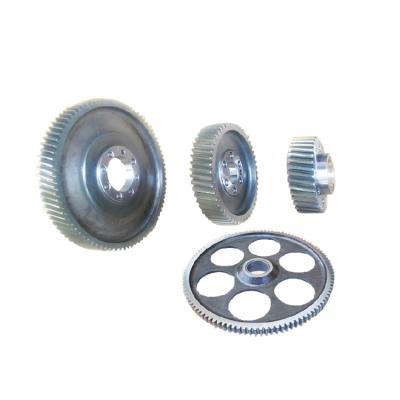
There are many types of gear shaft forgings. Commonly used gear forging materials are: 40Cr, 42CrMo, 20CrMnMo and 20CrMnTi, etc. 42CrMo and 40Cr forged gears are mostly large gear forgings in the lifting industry, 20CrMn molybdenum and 20CrMnTi are mostly used for transmission machinery forged gears, without main small parts (reference). Most gears require a boost gear. In 38-42HRC, the heat treatment hardness of the gear reaches good performance. Because the former has good heat treatment hardenability, the toughness of 42CrMo is much better than that of 40Cr, which is closely related to its material. Also, at the same hardness, the strength is very close. The tensile strength of 40Cr is 6~; the tensile strength of 42CrMo is 110kg/mm2, and the yield strength is 95kg/mm2. The performance is much better than 40Cr.
40Cr material has good hardenability. Water quenching can be hardened to a diameter of 28~60mm, and oil quenching can be hardened to a diameter of 15~40mm. After quenching and tempering, the material has good comprehensive mechanical properties with good low notch sensitivity and low temperature impact toughness. 40Cr gear forgings are usually subjected to surface induction quenching or nitriding treatment after quenching and tempering. When the hardness is 174~229HBS, it has good machinability, the relative machinability is 60%, and the carbon content of 40Cr material forgings is kept at about 0.40%, thus ensuring the good combination of strength and toughness of the steel. Add Cr element. (Cr,Fe)3C.
The main chemical composition (mass fraction) of 40Cr steel produced by gear shaft manufacturers is: 0.37%~0.44%. C, 0.17%~0.37%Si, 0.50%~0.80%Mn, 0.80%~1.10%cr, 0, ≤0.035%P, ≤0.035%S.
The phase transition points are: Ac1770°C, Ac3805°C, Ms328°C.
The initial forging temperature of 40Cr gear forgings is 1100~1150°C, and the forging temperature is 800°C. After forging, sizes over 60 mm need to be cooled slowly.
Gear shaft manufacturers remind: the material of the gear shaft forgings must first meet the requirements of the working conditions. When selecting gear forging materials, the requirements of working conditions should be considered first. Alloy steels are commonly used in the manufacture of gear forgings that work at high speeds, heavy loads, and shock loads. High reliability is required, and alloy steel with high mechanical properties must be selected. If the gear size is required to be as small as possible, a case-hardened high-strength alloy steel should be used. Gear transmission in mining machinery usually has high power, low working speed and high dust content in the surrounding environment, so materials such as cast steel or cast iron are often selected, but the transmission noise is small, and the working frequency of office machinery is low.